Health and Safety Policy for Landscaping Highbury
 This Health and Safety Policy sets out the standards and responsibilities that support safe, well-organised, and professional landscaping Highbury work. It applies to all employees, contractors, supervisors, and anyone involved in site activity. Our aim is to prevent injury, reduce risk, and maintain safe working conditions across every stage of a project. We are committed to a safety culture where planning, communication, and consistent control measures are treated as essential parts of daily operations.
Landscaping activities can involve powered tools, lifting, digging, planting, working with chemicals, and moving materials in changing outdoor conditions. Because of this, every task must be assessed before work begins. Risk awareness is central to our policy, and all workers are expected to follow safe systems of work, report hazards promptly, and use equipment correctly. Safety is everyone’s responsibility, and no task should continue if conditions are considered unsafe.
Before any project starts, a suitable risk assessment must be completed and reviewed by the person in charge. This includes checking access routes, ground conditions, weather exposure, nearby structures, underground services, and public safety. When required, control measures may include barriers, signage, manual handling limits, protective equipment, and restricting access to work areas. Good preparation reduces incidents and helps ensure that landscaping operations are completed efficiently and safely.
 All personnel must be trained to use tools, machinery, and materials in a safe and competent manner. Equipment should only be operated by authorised individuals, and pre-use checks must confirm that machines, cables, guards, and attachments are in good condition. Damaged or defective items must be taken out of service immediately. For landscape maintenance in Highbury and other outdoor tasks, safe handling of mowers, trimmers, cutters, and power tools is a key part of our control process.
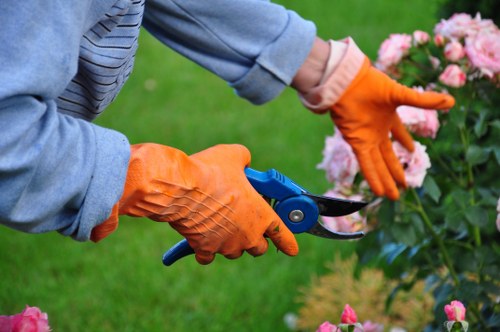
Personal protective equipment must be selected according to the task and worn where needed. Typical PPE may include safety boots, gloves, eye protection, hearing protection, high-visibility clothing, and weather-appropriate outerwear. Workers must understand that PPE is not a replacement for safe working practices; it is an additional layer of protection. Where dusty, noisy, or chemical-related work is carried out, the correct protective measures must be followed without exception.
Manual handling is another significant hazard in landscaping services. Materials such as soil, paving, timber, plants, and waste can create strain injuries if lifted incorrectly. Staff should plan lifts, reduce load weight where possible, use mechanical aids, and ask for assistance with awkward or heavy items. Training and good technique are expected at all times, and no one should be pressured to take on a lift that exceeds their capability.
 Safe use and storage of substances is essential, especially when using fertilisers, fuels, cleaning agents, or treatments for outdoor areas. All products must be clearly labelled, stored securely, and used in line with instructions. Spills should be contained and reported immediately. Workers handling chemicals must wash hands after use, avoid unnecessary exposure, and wear any required protective clothing. The policy encourages responsible landscaping operations that minimise harm to people and the environment.
Working at height is generally limited within landscaping, but it may still be necessary when trimming, installing features, or carrying out related tasks. Any such work must be carefully planned, supervised, and completed using suitable equipment. Ladders, platforms, and access aids must be stable and inspected before use. Where a safer ground-level alternative exists, that option should be preferred. We do not accept shortcuts when health and safety in landscaping can be improved through better planning.
Housekeeping is an important control measure across all worksites. Tools, offcuts, cables, packaging, and waste should be kept clear of walkways and work zones to prevent trips, slips, and falls. Materials must be stacked safely, and areas should be left tidy at the end of each shift. In addition, workers should remain alert to changing weather, poor visibility, uneven surfaces, and public movement nearby. These everyday precautions support reliable and safe Highbury landscaping standards.
Communication plays a major role in maintaining safe practice. Briefings should be given before work begins and whenever conditions change. Supervisors must confirm that hazards are understood and that workers know the correct procedures for the day. If an emergency occurs, staff should stop work, make the area safe if possible, and follow the established response process. First aid arrangements, incident reporting, and emergency awareness are all part of maintaining a professional landscaping safety policy.
Any accident, near miss, or unsafe condition must be reported as soon as possible so that lessons can be learned and corrective action taken. This policy is reviewed regularly to reflect changes in equipment, work methods, regulations, and site conditions. Continuous improvement is essential, and all workers are expected to contribute by raising concerns and supporting safer ways of working. A strong safety culture depends on honest reporting, proper supervision, and consistent standards.
 The management team is responsible for ensuring that adequate resources, training, and supervision are in place for safe working. Workers are responsible for following instructions, using equipment properly, and taking reasonable care of themselves and others. Clients, visitors, and the public must also be protected through effective planning and site control. This policy applies to all landscaping Highbury projects, regardless of size, and forms part of our commitment to lawful, careful, and competent service delivery.
 By following this policy, we aim to prevent harm, protect property, and maintain a high standard of workmanship in every project. Safe landscaping depends on attention to detail, sensible risk control, and respect for the working environment. Our approach combines practical procedures with a clear expectation that safety comes first, every time. All staff are required to uphold these principles while carrying out landscaping services in a reliable and responsible way.